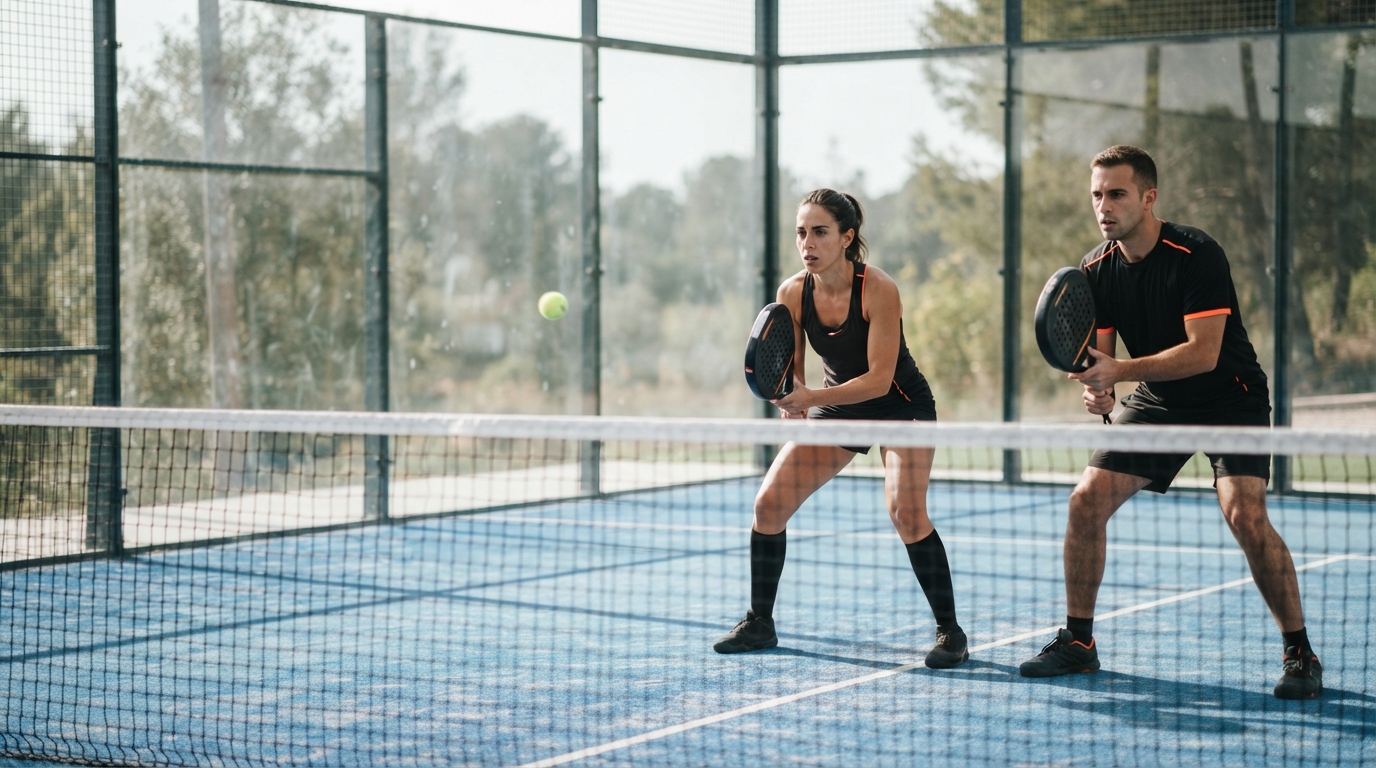
Not long ago, analyzing your jump shot or tennis serve required either a professional coach or hours of manual video review. In 2026, artificial intelligence has changed all of that. AI-powered training tools are now accessible to recreational players, student-athletes, and competitive amateurs — not just professionals with million-dollar training budgets.
Whether you play basketball, tennis, or volleyball, AI tools are actively reshaping how athletes train, identify weaknesses, and accelerate improvement. This guide breaks down what these tools are, how they work across different court sports, and how you can start using them to train smarter.
What Are AI Training Tools in Sports?
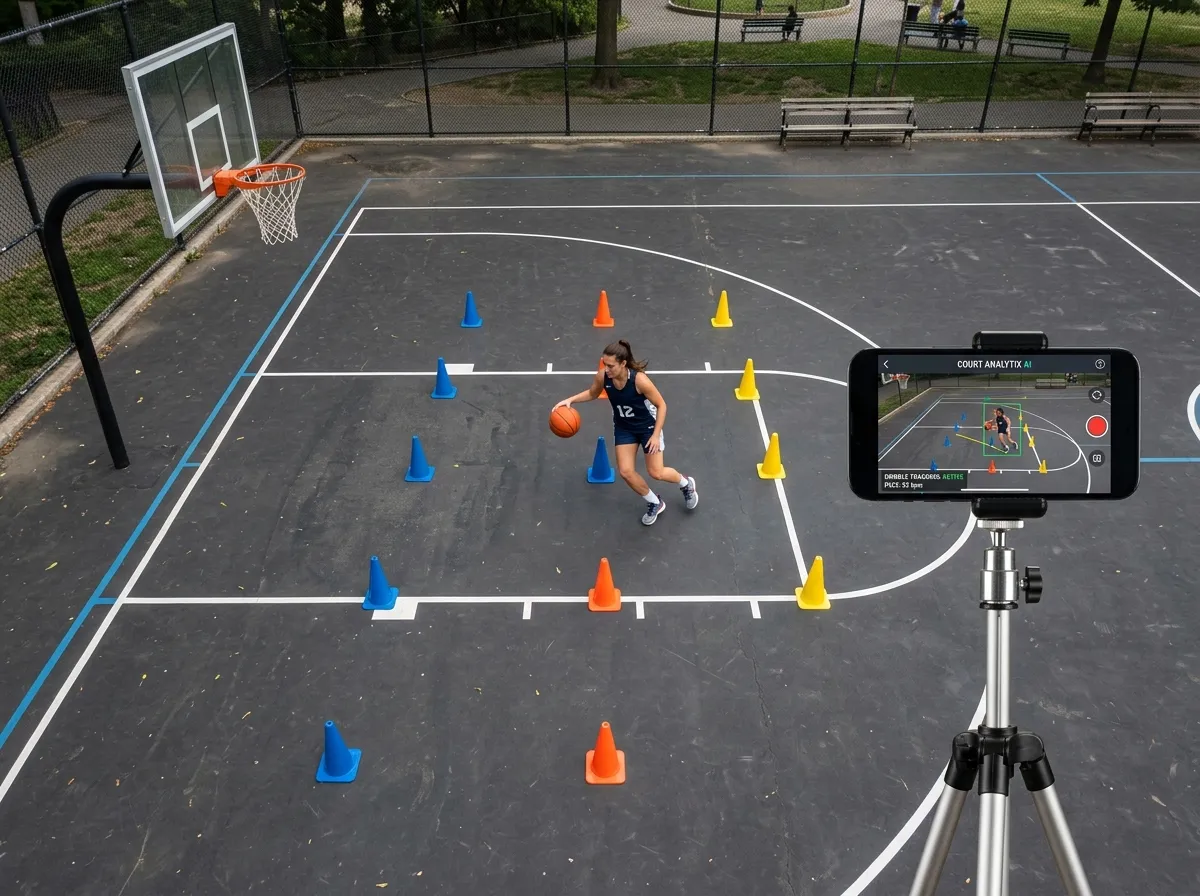
AI training tools in sports are software platforms, hardware devices, and mobile applications that use artificial intelligence — including computer vision, machine learning, and data analytics — to track athletic performance, analyze movement, and deliver personalized feedback.
Unlike traditional video recording, which requires manual review, AI systems process footage automatically and in real time. They identify specific patterns — release angles, footwork efficiency, reaction time, muscle activation — and translate those patterns into actionable coaching insights.
According to the NCAA’s Performance Technology recommendations, performance technologies are devices that enable users to collect and record biometric and performance data, and their responsible use can directly support athlete health, safety, and performance at every level of competition.
What makes the current wave of tools different from earlier analytics systems is accessibility. You no longer need a lab, a team of analysts, or expensive tracking infrastructure. Many of today’s AI training platforms require nothing more than a smartphone and a tripod.
AI Training Tools for Basketball Players
Basketball has become one of the most data-rich sports in the world. At the professional level, systems track every player’s movement, every possession, and every shot taken. In 2026, versions of that same technology will be available to players training in local gyms and outdoor courts.
Shooting Analysis Apps
AI-powered shooting analysis apps use computer vision to evaluate your shooting form frame by frame. You set up a smartphone or tablet with a view of your shooting motion, and the app breaks down your arc, release point, elbow alignment, follow-through, and shot accuracy — all without a human coach present.
These tools generate heat maps of where your shots land on the court, track your accuracy percentage across different zones, and flag mechanical inconsistencies that repeat across attempts. Over multiple sessions, they identify trends — for example, that your release drops when you shoot from the left corner, or that your arc flattens when fatigued late in a workout.
For players working on their fundamentals, these apps serve as an always-available feedback mechanism. Rather than waiting for your next coaching session to identify a flaw in your form, you get feedback immediately after each shot, which accelerates the correction cycle significantly. If you are still building the fundamentals of your shooting mechanics, our guide on basketball court awareness pairs well with this kind of tool, helping you train both your physical game and your decision-making at the same time.
Movement and Positioning Trackers
Beyond shooting, AI tools now analyze how players move on the court without the ball. Computer vision systems track your off-ball positioning, defensive rotations, and transition speed. Coaches can use this data to identify whether a player consistently fails to rotate on defense or repeatedly takes poor angles to the basket on drives.
For team training environments, multi-player tracking systems can analyze spacing, pick-and-roll recognition, and help defense positioning simultaneously — giving coaches a data-backed picture of how their entire system operates rather than focusing on individual players in isolation.
AI Training Tools for Tennis Players
Tennis is an individual sport built around technical precision, and AI tools have found an ideal home in the game. The variety of shots, the importance of biomechanics, and the measurability of performance metrics make tennis one of the most compatible sports with AI-driven coaching.
Smart Rackets and Wearable Sensors
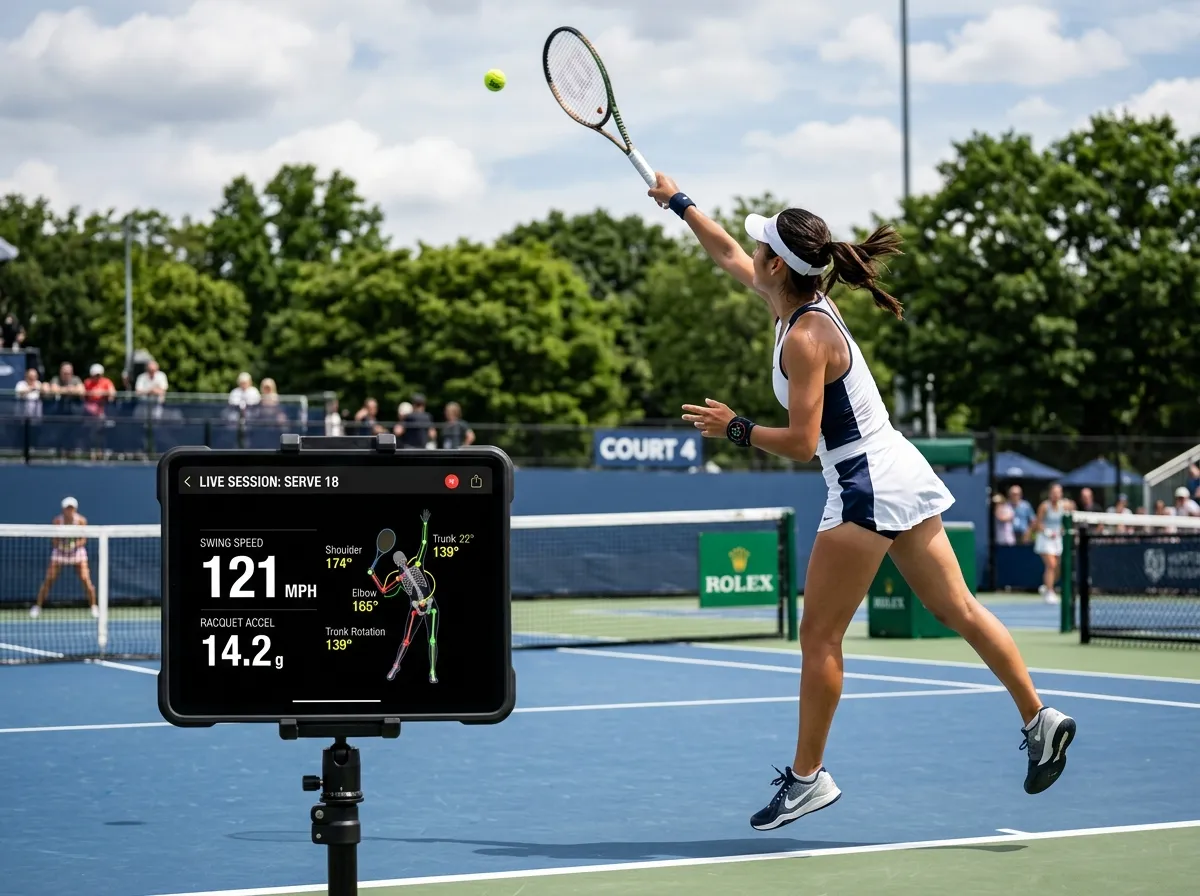
Smart rackets embedded with sensors now measure swing speed, spin rate, ball contact point, and grip pressure on every single shot. This data syncs with a connected app and lets players and coaches visualize exactly how each shot was generated — not just whether it went in, but how it was produced mechanically.
Wearable devices add a second layer by monitoring physical load, heart rate variability, and muscular fatigue throughout a session. When you can see that your serve mechanics deteriorate in the third set and that your heart rate variance confirms physical fatigue, the data gives you something concrete to address — whether through conditioning work, better pacing, or recovery protocols between sets.
AI Ball Machines and Training Robots
Traditional ball machines fire repetitive shots at fixed speeds and locations. AI-powered successors do something fundamentally different. They use computer vision to monitor your court position and adapt their next delivery based on where you are standing, how you just played the previous ball, and what your current skill level suggests you need to work on next.
Systems like LUMISTAR’s TERO — unveiled at CES 2026 — feature angle auto-calibration, dual 4K cameras, trajectory prediction, and real-time shot quality evaluation. The machine adjusts its next delivery parameters instantly based on how well you returned the previous ball, creating a dynamic training loop that mirrors the unpredictability of a live opponent.
For players who train without regular hitting partners or access to a dedicated coach, this kind of AI training machine provides structured, purposeful practice sessions that were previously only available in professional academies.
Video Analysis and Virtual Coaching
AI video analysis platforms allow you to film your own matches or practice sessions and receive automated breakdowns of your performance. The software tags every shot by type, tracks your court positioning throughout points, and compares your shot tendencies to statistical patterns associated with effective play at your level.
Some platforms also offer AI-driven coaching assistants that analyze your patterns and suggest a personalized practice plan. Rather than a generic drill program, you receive targeted exercises based on your actual weaknesses — identified directly from your match data.
AI Training Tools for Volleyball Players
Volleyball presents a unique set of training challenges. The sport demands explosive power, precise timing, coordinated team movement, and split-second decision-making — all within the span of a single rally. AI tools are addressing each of these demands with increasingly sophisticated solutions.
Jump and Spike Analysis
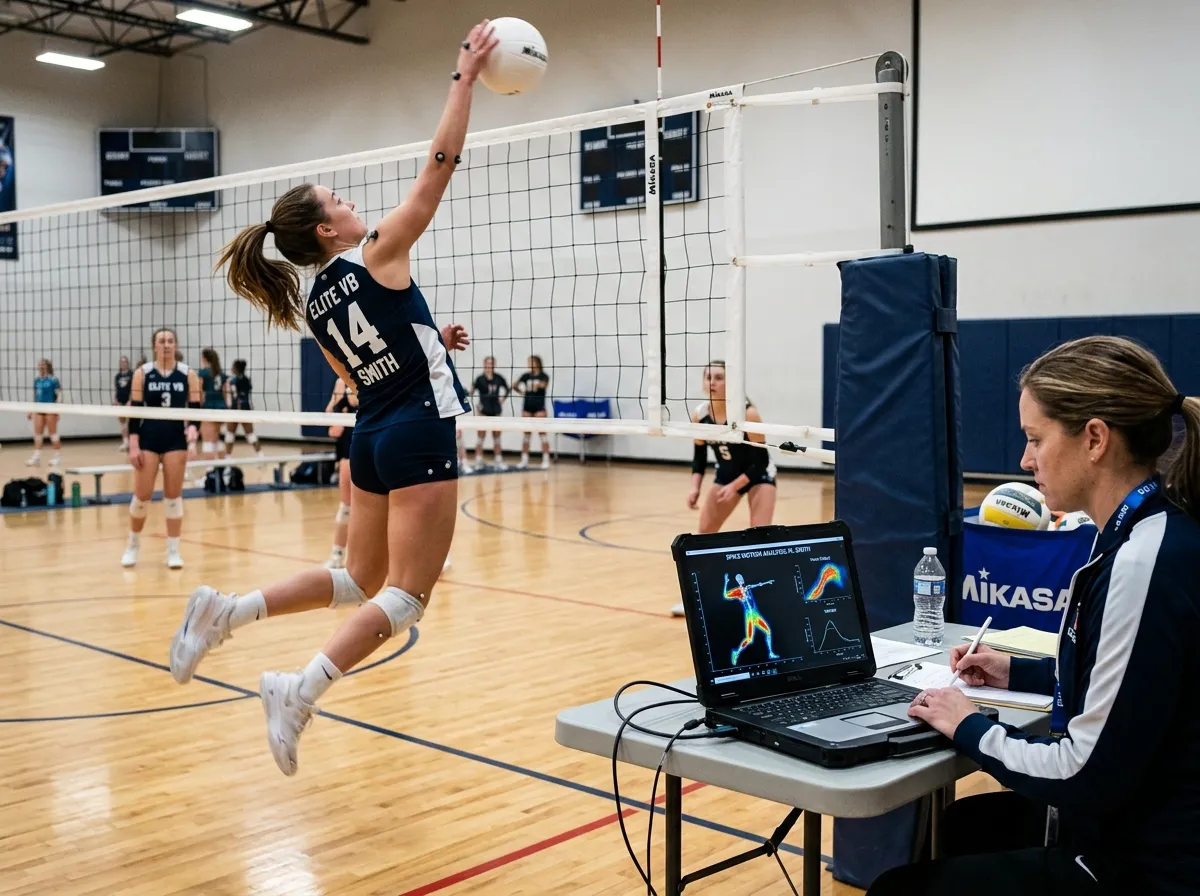
One of the most performance-critical skills in volleyball is the attacking approach and jump. AI motion capture systems now analyze your approach footwork, takeoff mechanics, arm swing timing, and contact point on each spike — flagging inefficiencies that reduce power or increase injury risk.
These systems can detect, for example, that your penultimate step is too long and reduces your vertical jump height, or that your arm swing initiates too early, costing you power at the point of contact. These are precisely the kinds of micro-level corrections that coaches previously needed to observe manually and explain verbally — now surfaced automatically with visual data to support the feedback.
Serve, Receive, and Defensive Positioning
Defensively, AI tools analyze passing accuracy, platform angle, and body position at the moment of contact on serve receive. Over time, the data reveals consistent patterns in where a player’s passing breaks down — whether under high-pace serves, jump serves from the left side, or balls directed to their weaker hand side.
Team-level positioning analysis helps coaches identify whether their defensive system is executing as designed. Heatmaps of player positions across an entire match reveal whether rotations are happening correctly, where defensive gaps consistently appear, and which opponents’ attack patterns are most effective against the current system.
For context on how volleyball’s competitive landscape is evolving alongside these training advances, our article on volleyball’s 2026 FIVB rule changes covers the structural shifts happening at the organizational level of the sport.
How to Get Started With AI Training Tools
The range of available tools can feel overwhelming, but getting started does not require a large investment. Here is a practical framework for incorporating AI training into your routine regardless of your budget or sport.
Start With a Smartphone App
The most accessible entry point is a smartphone-based analysis app for your specific sport. Basketball shooting apps, tennis stroke analyzers, and volleyball jump trackers are widely available and many offer free tiers with core functionality. All you need is your phone, a stable mount or tripod, and a court.
Spend two to three sessions gathering baseline data before making any changes. The value of these tools comes from trends over time, not from a single session snapshot. Once you have a baseline, use the feedback to identify your one or two most consistent mechanical flaws and focus your next training block on correcting those specific issues.
Combine Data With Intentional Practice
AI tools provide the diagnosis, but they do not replace deliberate practice. Use the data to design specific drills that address the weaknesses identified by the tool, then track whether those metrics improve over successive sessions. This creates a training loop — data, drill design, execution, measurement — that accelerates improvement far more effectively than unstructured repetition.
As MIT Sloan Management Review has noted in its research on analytics in the sports industry, the most effective use of data in athletic contexts always starts with a clear performance question — not with the technology itself. Ask what specific aspect of your game you want to improve, then identify the tool that best measures that dimension.
Layer in More Advanced Tools Over Time
Once you are comfortable using basic apps, consider adding wearable sensors for physical load monitoring, smart equipment for real-time biomechanical feedback, or an AI ball machine if your sport and training context make that feasible.
The goal is not to use every available tool simultaneously — it is to build a training environment where data reinforces your coaching, your drills are targeted to your actual needs, and your progress is measurable over time. Start simple, stay consistent, and let the data guide your next investment.
What AI Training Tools Cannot Replace?
 Despite their capability, AI training tools have real limitations that every athlete should understand before investing time and money in them.
AI tools excel at identifying mechanical patterns and measuring physical output. They do not yet reliably evaluate the mental dimensions of sport — composure under pressure, competitive decision-making, communication with teammates, or the ability to adapt tactically within a live match. These remain the domain of human coaching, game experience, and psychological training.
They also cannot replicate the competitive environment of real play. Drilling your serve mechanics against an AI ball machine is valuable, but it does not simulate the pressure of a deciding game or the chaos of an opponent serving to an unexpected location. For court sports athletes, a live match experience remains irreplaceable.
Used well, AI tools are a powerful complement to coaching and competition — not a replacement for either. The players who will benefit most are those who use data to guide their deliberate practice and then take what they have learned into real competitive environments where the full complexity of the game tests every dimension of their performance.
Train Smarter, Not Just Harder
The training landscape for court sports athletes has changed dramatically. The same analytical capabilities that elite professional programs have relied on for years are now available to anyone willing to set up a phone camera and put in the work. AI training tools will not make you a better player by themselves — but they give you a level of clarity about what to work on, and how to measure progress, that simply was not available to most athletes even a few years ago.
Start with the sport you play, identify the one or two areas where targeted improvement would make the biggest difference, and find the simplest tool that measures those areas well. Build from there. The court sports athletes who train smarter in 2026 will be the ones who perform better — and who enjoy the process of getting there.
For more guides across basketball, volleyball, tennis, and the full world of court sports, explore everything available in our Training & Performance section and our Court Sports Insights articles.