Tennis is one of the most rewarding sports you can pick up at any age. It builds fitness, sharpens reflexes, tests your mental composure, and gives you a skill set you can enjoy for life. But for many beginners, the first barrier is not the physical game — it is understanding how tennis actually works. The scoring system is unlike any other sport, the rules have their own vocabulary, and the court markings can look confusing at first glance.
This guide breaks all of it down clearly. By the time you finish reading, you will understand the court, the rules, how to keep score, what the essential shots are, and how to take your first confident steps onto the court.
Understanding the Tennis Court
Before you can play tennis, you need to understand the space you are playing in. A standard tennis court is a rectangle, 78 feet long and 27 feet wide for singles play. For doubles, the width extends to 36 feet to include the outer alleys on each side. A net runs across the center of the court, standing 3.5 feet high at the posts and 3 feet high at the center.
The Key Lines and Zones
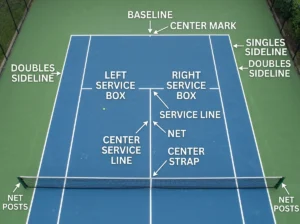
The court is divided into several zones, each with its own purpose during play. The baseline runs along the back of each side — this is where most groundstrokes are hit from and where the server stands before each point. The service line runs parallel to the net roughly halfway between the net and the baseline. The area between the net and the service line is divided into two service boxes — one on the left and one on the right — and this is where a serve must land to be considered valid.
The center mark on the baseline divides the server’s starting position. Servers alternate between standing to the right and left of this mark depending on the point being played. The singles sidelines define the in-bounds area for singles play, while the wider doubles alleys — the narrow strips on each outer edge — are only in play during doubles matches.
Any ball that lands on a line is considered in. A ball that lands beyond any boundary line — including the baseline or sideline — is out and loses the point for the player who hit it.
Court Surfaces
Tennis is played on several different surfaces, and each affects how the ball behaves. Hard courts — the most common surface worldwide — produce a consistent, medium-paced bounce. Clay courts slow the ball down and produce a higher bounce, favoring longer rallies and baseline play. Grass courts produce a fast, low bounce that rewards serve-and-volley play. As a beginner, you will most likely start on a hard court, which is the most forgiving and predictable surface.
The Basic Rules of Tennis
Tennis follows a clear set of rules governed internationally by the Lawn Tennis Association and the International Tennis Federation. Here are the essential rules every beginner needs to know before stepping on the court.
The Serve
Every point begins with a serve. The server stands behind the baseline and must hit the ball diagonally into the opponent’s service box on the other side of the net. For the first point of each game, the server stands to the right of the center mark and serves into the left service box across the net. They alternate sides — right, then left — for each subsequent point within the game.
The serve must clear the net and land within the correct service box. If it does not, it is called a fault. The server gets two attempts to land a valid serve. Missing both is called a double fault, and the opponent wins the point automatically.
If the serve clips the top of the net but still lands in the correct service box, it is called a let — a neutral outcome — and the server simply replays that serve without penalty. Let’s can happen on either the first or second serve.
Rally and Point Play
After a successful serve, the point continues as a rally — both players hitting the ball back and forth over the net. Each player is allowed one bounce per shot before they must return the ball. Hitting the ball before it bounces — called a volley — is also legal, except when the ball is served.
A player loses the point when they hit the ball into the net, hit it out of bounds, allow it to bounce twice before returning it, or touch the net with their body or racket at any point during the rally. Points are won by forcing your opponent into one of these errors, or by hitting a shot they simply cannot reach.
Changing Ends
Players switch ends of the court after the first game, and then after every two games following that. During a tiebreak, players switch ends every six points. This rule exists to ensure that neither player is permanently disadvantaged by factors like wind, sun angle, or court condition.
How Tennis Scoring Works

Tennis scoring is one of the first things that confuses new players — and understandably so. It uses a system unlike any other major sport. According to the United States Tennis Association’s official scoring guide, tennis aims to win enough points to win a game, enough games to win a set, and enough sets to win a match. Here is how each layer works.
Points Within a Game
Points within a game are not scored as 1, 2, 3. Instead, tennis uses the sequence love, 15, 30, 40, and game. Love means zero. So the progression for a player winning four straight points from the start of a game goes: love, 15, 30, 40, game.
The score is always announced with the server’s score first. If the server has won two points and the receiver has won one, the score is 30 — 15. If the receiver is leading with two points to the server’s one, it is still announced as 15 — 30.
When both players reach 40 — 40, the score is called deuce. From deuce, one player must win two consecutive points to win the game. The first point won after a deuce gives that player an advantage. If the player with advantage wins the next point, they win the game. If they lose it, the score returns to deuce, and the process begins again. This can repeat as many times as needed.
Winning a Set
A set is won by the first player to reach six games — but with a catch. You must win by a margin of at least two games. So winning 6 — 4 or 6 — 3 takes the set cleanly. Winning 6 — 5 does not — you must continue until you either reach 7 — 5 or the set reaches 6 — 6, at which point a tiebreak is played.
A tiebreak is a mini-game played to seven points, with a minimum two-point margin required to win. Tiebreak points are scored as regular numbers — 1, 2, 3, and so on. The player who wins the tiebreak wins the set 7 — 6. Players switch ends of the court during the tiebreak every six points.
Winning a Match
Most recreational and competitive matches are played as the best of three sets. The first player to win two sets wins the match. Some professional and tournament formats — particularly Grand Slam men’s singles — use best of five sets, requiring three sets to win.
A common match score might look like 6 — 3, 4 — 6, 6 — 4 — meaning the winner took the first set 6 — 3, lost the second 4 — 6, and won the deciding third set 6 — 4.
The Essential Shots Every Beginner Should Learn
You do not need to master every shot in tennis before you start playing. As a beginner, building confidence and consistency with a small set of fundamental shots will carry you a long way.
The Forehand Groundstroke
The forehand is the most natural shot for most beginners and the one you will hit most often during rallies. It is struck with your dominant hand leading the swing, making contact with the ball on that same side of your body. A reliable forehand starts with good footwork — getting into position early, turning your hips and shoulders toward the ball, and swinging through with your body weight transferring forward through contact.
Focus first on making clean, consistent contact and keeping the ball in play. Power comes later, once your mechanics are reliable. A consistent forehand that lands in the court will win far more points at the beginner level than an inconsistent attempt to hit hard.
The Backhand Groundstroke
The backhand is hit on the opposite side of your body from the forehand. Beginners have two options: a two-handed backhand, which provides more stability and control and is the most common choice for new players, or a one-handed backhand, which offers greater reach and variety but requires more technique to develop reliably.
The same principles apply as the forehand — good positioning, early preparation, and contact in front of your body. The backhand often feels less natural at first, but with practice, it becomes just as dependable as the forehand for most players.
The Serve
The serve is technically the most complex shot in tennis — it is the only one where you have complete control over the ball before striking it. As a beginner, do not worry about hitting hard. A slow, consistent serve that lands in the service box is far more valuable than a powerful serve that produces constant double faults.
A basic beginner serve involves a smooth toss slightly in front of and above your hitting shoulder, a full arm swing upward, and a contact point at the peak of your reach. Practice the toss and swing separately before combining them. Developing a reliable serve early makes every game easier to manage.
The Volley
A volley is any shot hit before the ball bounces — usually played close to the net. Volleys are punchy, compact strokes rather than full swings. The goal is to redirect the ball cleanly into an open area of the opponent’s court. Volleys are most common in doubles play, but they appear in singles whenever a player approaches the net to finish a point.
Tips for Your First Time on the Court
Knowing the rules and understanding the shots is a strong start. Here are a few practical tips to make your first sessions on the court more enjoyable and productive.
Start With Rallying, Not Scoring

When you first pick up a racket, the goal should be to simply keep the ball in play — not to win points. Rally with a partner from the service line rather than the full baseline. A shorter distance gives you more time to react, builds confidence in your groundstrokes, and makes the experience immediately enjoyable rather than frustrating. Move to the baseline gradually as your consistency improves.
Focus on Footwork First
Most beginner errors in tennis are footwork errors, not technique errors. Getting to the ball too late, standing flat-footed, or being out of position forces rushed, off-balance contact that produces poor shots regardless of how good your swing mechanics are. Train yourself to move early, split-step as your opponent contacts the ball, and recover to a central position after each shot.
Learn the Score as You Play
Do not wait until you fully understand the scoring system before you start playing. The fastest way to learn it is to call the score out loud on every point during your first few sessions. Saying the score aloud reinforces the sequence — love, 15, 30, 40, deuce — and makes it feel natural within a few games. You will have it memorized before you realize it.
Use the Right Equipment
As a beginner, you do not need an expensive racket. Look for a lightweight frame with a larger head size — typically 100 to 110 square inches — which provides a more forgiving sweet spot for off-center contact. Standard pressurized tennis balls are fine for most recreational courts. If you are playing on a hard court that feels fast, slower practice balls can help extend rallies while you build consistency.
How Tennis Connects to the Broader World of Court Sports
One of the great things about starting tennis is that the skills you develop transfer directly to other court sports. Footwork, reading the game, court positioning, and composure under pressure are all qualities that make you a better player, regardless of which sport you are in.
If you are exploring which racket sport suits you best — or whether tennis, padel, or pickleball is the right starting point — our detailed comparison in Tennis vs. Padel vs. Pickleball: Which Racket Sport Is Right for You? walks through the key differences across all three sports. For players who want to build their mental game alongside their physical skills from the very beginning, our guide on mental performance training for court sports athletes covers the psychological side of competing well under pressure — a dimension of tennis that matters from your very first match.
Tennis is a sport that rewards consistency, patience, and smart play far more than it rewards raw athleticism. Start with the fundamentals, enjoy the process of learning, and the game will keep giving you new challenges and new rewards for as long as you play it. Explore more guides across every court sport in our Court Sports Insights section.