
Training hard has always been part of the equation for court sports athletes. But training smart — understanding exactly how your body is responding, recovering, and performing — is what separates athletes who plateau from those who keep improving. In 2026, wearable technology makes that level of insight accessible to players at every level, not just professionals with full support staff behind them.
Whether you play basketball, tennis, or volleyball, there is now a growing category of smart gear designed specifically to help you monitor your output, protect your body, and make better decisions about how you train and recover. This guide covers what wearable tech can do for court sports athletes, which categories of devices matter most, and how to use them effectively without overcomplicating your training.
Why Wearable Tech Matters for Court Sports
Court sports are physically demanding in a very specific way. They require explosive bursts of speed and power, rapid directional changes, sustained cardiovascular effort, and the ability to perform precise technical skills under fatigue. That combination puts significant stress on the body — and without data, it is difficult to know whether you are training at the right intensity, recovering adequately, or approaching the kind of overload that leads to injury.
According to a peer-reviewed study published in MDPI Applied Sciences on wearable technology in sports, wearable devices now cover a wide range of measurable performance dimensions — from inertial sensors that capture jump height, acceleration, and directional movement, to biometric monitors that track heart rate variability, oxygen saturation, and recovery readiness. The value is not in the data alone — it is in how athletes and coaches use that data to make better decisions about training load, recovery timing, and skill development.
For court sports athletes specifically, the ability to quantify explosive movement, monitor cardiovascular demand, and track recovery between sessions gives both players and coaches a concrete foundation for planning training blocks and managing workload across a competitive season.
Fitness and Recovery Trackers
The most widely used category of wearable tech for athletes is the continuous health and recovery tracker. These devices are worn around the clock — not just during training — and build a picture of how your body is adapting to the physical demands placed on it.
What Recovery Trackers Measure
The most performance-relevant metrics for court sports athletes include heart rate variability (HRV), resting heart rate, sleep quality and duration, and respiratory rate. HRV in particular has emerged as one of the most reliable indicators of physiological readiness — a higher HRV on a given morning generally signals that your nervous system has recovered well and your body is primed for a demanding session. A low HRV suggests the opposite.
Recovery trackers use these metrics to generate a daily readiness score, which athletes can use to calibrate training intensity. On a high-readiness day, pushing hard in practice makes sense. On a low-readiness day — perhaps following a late game, a heavy training block, or disrupted sleep — reducing intensity or focusing on technical work rather than conditioning protects the body and supports long-term performance.
WHOOP for Court Sports Athletes
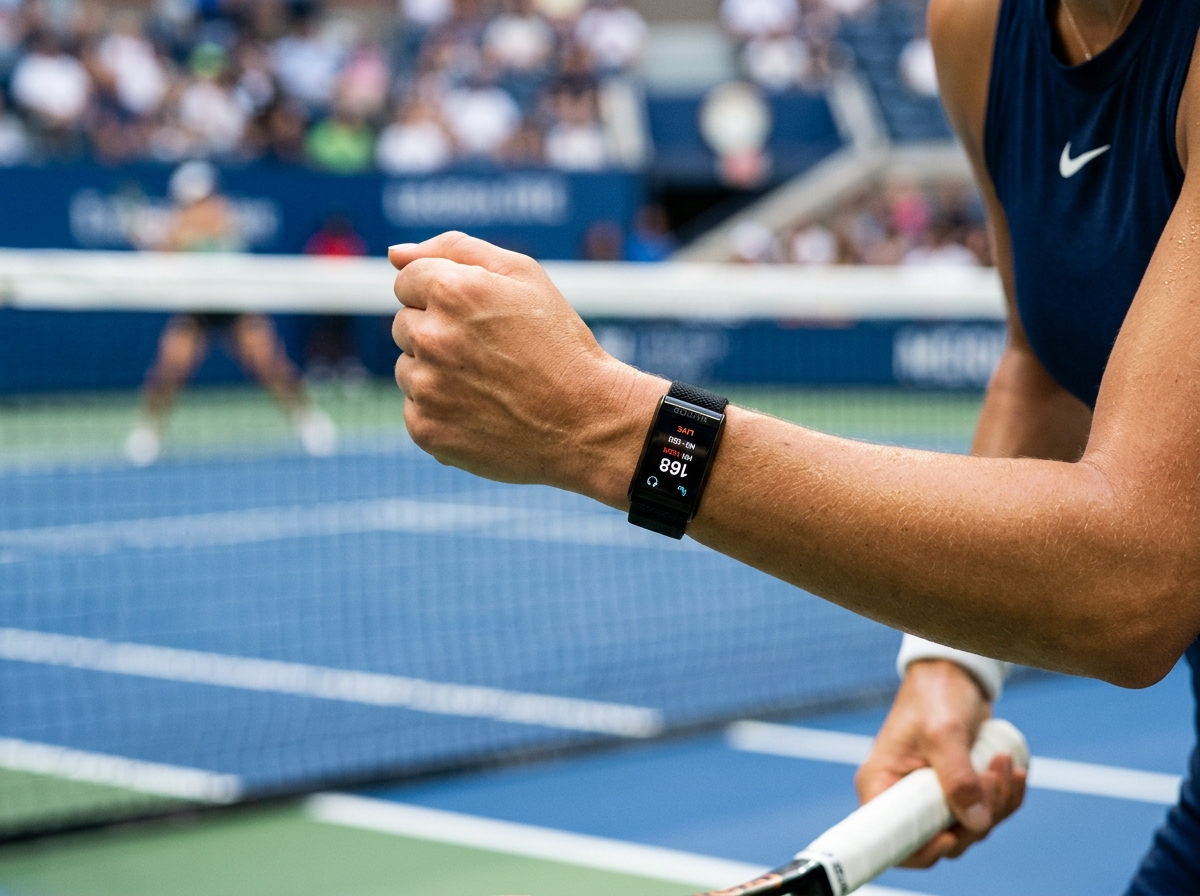
One of the most widely adopted recovery-focused wearables among competitive athletes is WHOOP. WHOOP delivers continuous health tracking across sleep, strain, stress, and recovery — measuring metrics that have the biggest impact on athletic performance and translating them into daily coaching recommendations. Its strap design is unobtrusive, and the device tracks data 24 hours a day including during sleep, providing a complete view of how training and lifestyle choices are affecting recovery.
WHOOP is already approved for in-match use on the WTA tennis tour, making it one of the few wearables validated for competitive court use at the professional level. For recreational and competitive amateur players across basketball, tennis, and volleyball, it provides the same physiological visibility that professional programs rely on — in a format accessible to individual athletes training independently.
Using Recovery Data Effectively
The most important principle when using any recovery tracker is consistency. A single data point tells you very little. A two-week trend reveals meaningful patterns — for example, that your HRV consistently drops after back-to-back training days, or that your sleep quality degrades significantly during high-stress competition weeks. Those patterns give you and your coach something concrete to act on.
Do not treat a low readiness score as a reason to skip training entirely. Use it as guidance for how to train that day — less intensity, more technical focus, or a deliberate recovery session — rather than a binary decision between training and rest.
Movement and Performance Tracking Devices
Beyond recovery, a second category of wearable tech focuses on measuring what you do during training — how you move, how hard you work, and how your mechanics look over time. For court sports athletes, this is where wearables start to directly influence skill development.
Inertial Sensors and Motion Trackers
Inertial sensor systems — small devices worn on the wrist, ankle, or torso — use accelerometers and gyroscopes to capture movement data in three dimensions. For basketball and volleyball players, these sensors can measure jump height, landing impact force, acceleration into cuts, and total physical load accumulated across a session.
This data is particularly valuable for managing injury risk. Repeated high-impact landings are a known contributor to lower extremity injuries in court sports. When an inertial sensor shows that a player is accumulating unusually high landing impact loads during a given session, coaches can make informed decisions about modifying drills, reducing volume, or adding targeted recovery work — before the body gives a more painful signal.
Smart Rackets and Stroke Sensors for Tennis
Tennis players have access to a category of wearable tech that does not translate directly to other sports — smart racket sensors and wrist-based stroke trackers. These devices attach to the handle of a racket or are worn on the wrist and measure swing speed, spin rate, shot power, contact point consistency, and stroke volume per session.
For developing players, stroke sensor data provides immediate feedback on the physical parameters of each shot — not just whether it went in, but how it was generated. Knowing that your flat serve averages 15% less racket head speed than your slice serve, or that your forehand topspin rate drops in the third set, gives you something specific to address in your next practice block rather than relying on feel alone.
If you are also using AI-powered tools to analyze your court movement and shot selection, stroke sensors complement that data well by adding the physical execution layer. Our article on AI training tools for court sports athletes covers how these technologies work together to build a complete training feedback system.
Smart Footwear and Compression Gear
Wearable technology is no longer limited to wristbands and sensors. Smart footwear and compression garments have entered the court sports market as practical tools for performance monitoring and recovery support.
Sensor-Equipped Athletic Shoes
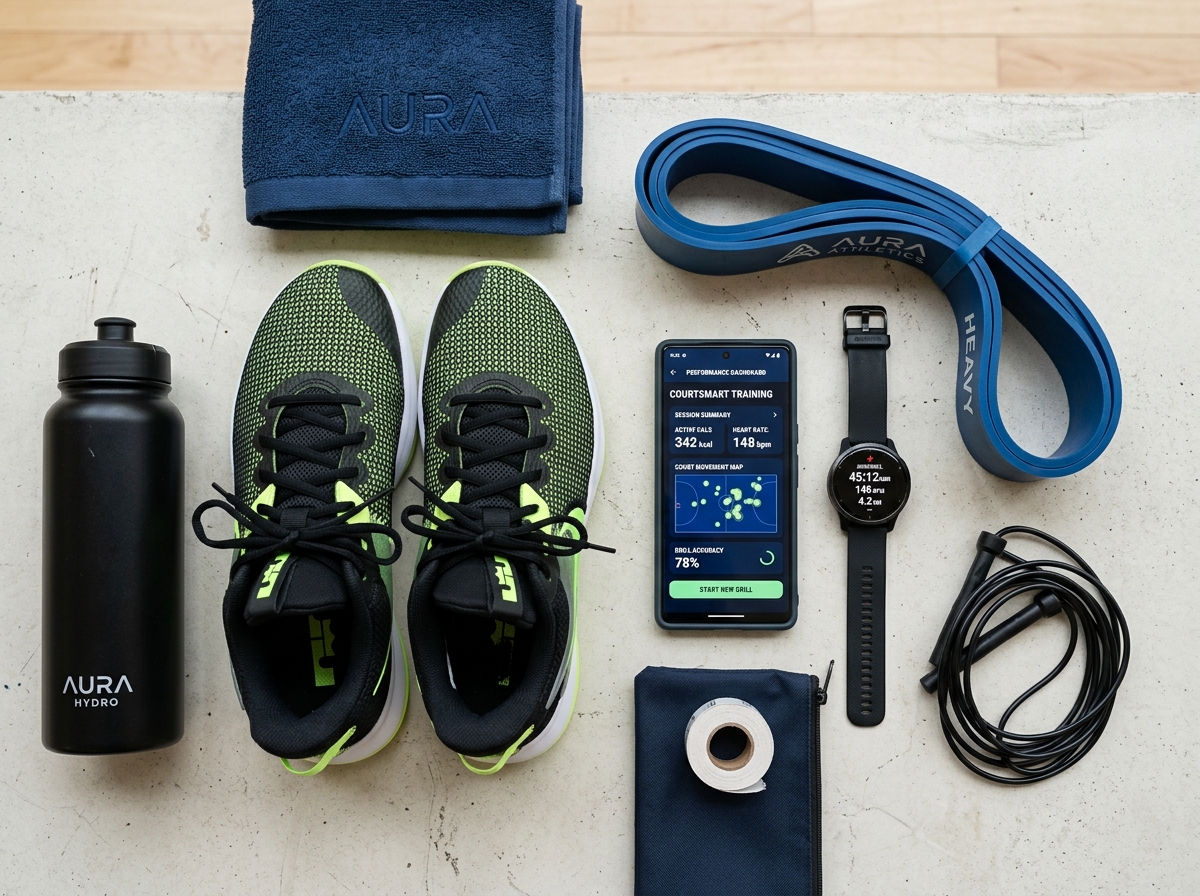
Smart footwear embeds pressure sensors and motion tracking into the insole or sole of the shoe, capturing data on foot strike pattern, weight distribution, lateral force during cuts, and ground contact time. For court sports athletes who make hundreds of rapid directional changes per session, this data reveals asymmetries in movement patterns that are often invisible to coaches and athletes — imbalances that, left unaddressed, contribute to overuse injuries over time.
Basketball and volleyball players in particular benefit from footwear data given the frequency of high-force lateral movements and jump landings in both sports. Identifying that a player consistently lands with greater force on their left foot, or that their foot strike pattern changes under fatigue, allows targeted corrective work before those patterns become injury risk factors.
Compression Gear With Biometric Monitoring
Smart compression garments — including shorts, leggings, and upper body tops — embed biometric sensors directly into the fabric. These garments monitor muscle activation patterns, heart rate, and movement quality during training without requiring a separate device strapped to the body.
For court sports athletes, the practical advantage of smart compression gear is that it integrates seamlessly into existing training attire. There is no additional device to remember, no placement adjustment required between drills, and no impact on movement freedom. The data syncs wirelessly to a companion app and is available for review after each session.
How to Choose the Right Wearable for Your Sport
The range of available wearable tech can feel overwhelming — particularly when each device claims to measure everything you need. The practical approach is to match the tool to the specific performance question you are trying to answer.
Start With One Clear Goal
Before purchasing any wearable device, identify the single most important thing you want to measure. If your primary concern is recovery and avoiding overtraining, a continuous health tracker like WHOOP is the right starting point. If you want to understand your physical output during sessions — how hard you are working, how high you are jumping, how your load accumulates across a week — an inertial sensor or training load monitor is the more relevant choice. If you play tennis and want direct feedback on your stroke mechanics, a racket sensor or wrist-based stroke tracker is the most targeted option.
Buying multiple devices simultaneously before you have established a baseline with any single one produces a flood of data and very little actionable insight. Start with one tool, use it consistently for four to six weeks, and let the data guide your next decision.
Matching Devices to Your Sport
Basketball players benefit most from devices that track explosive movement, jump metrics, training load, and recovery — inertial sensors and continuous recovery trackers are the highest-value starting points. Tennis players gain the most from stroke sensors and recovery trackers, particularly given the physical demands of match play and the technical precision the sport requires. Volleyball players benefit strongly from jump and landing analysis tools alongside recovery monitoring, given the high volume of vertical movement the sport demands in both training and competition.
For players competing across multiple court sports — or those training in padel, pickleball, and other racket sports alongside their primary game — a continuous recovery tracker provides the most universal value, since it measures physiological readiness regardless of which sport generated the training stress. If you are still deciding which court sport best suits your interests and training goals, our comparison of tennis, padel, and pickleball is a useful starting point.
Integrate Data With Your Existing Training
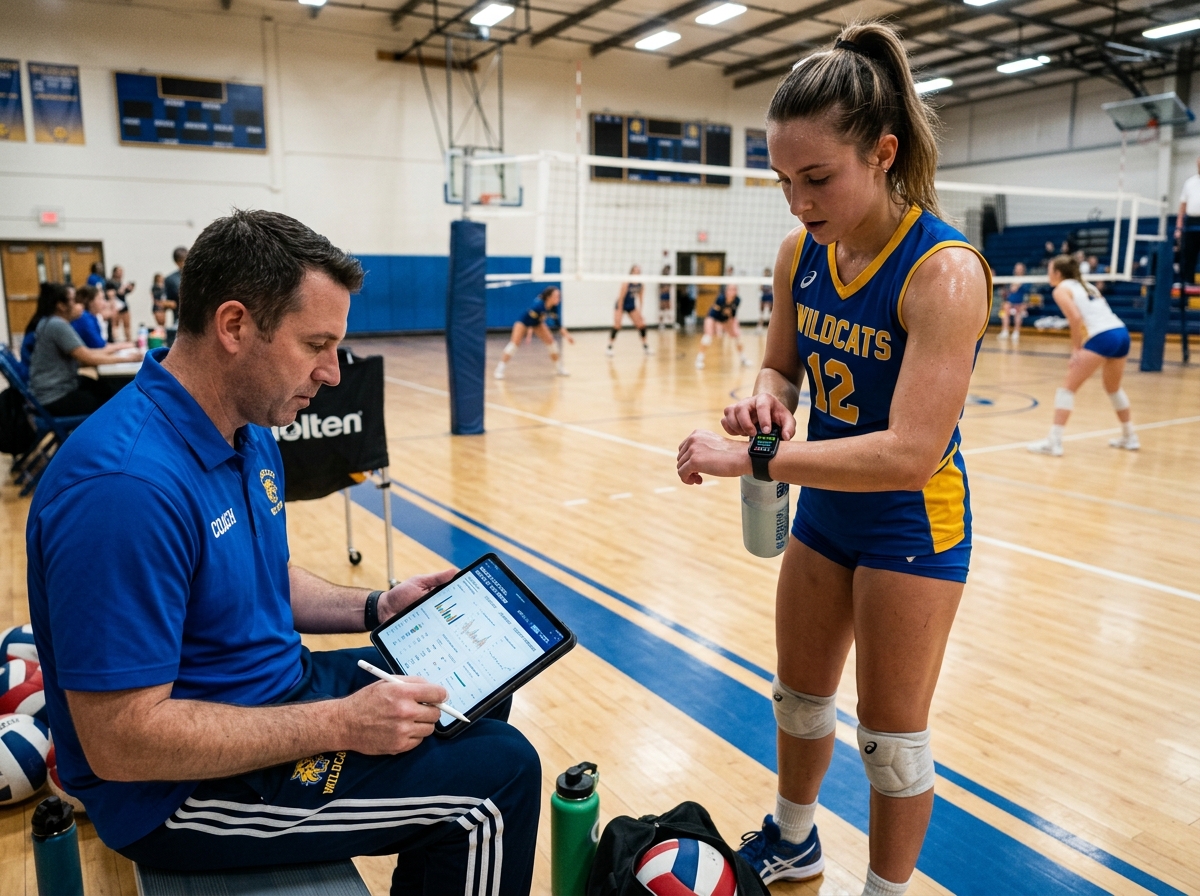
Wearable technology is a tool that enhances good training — it does not replace it. The athletes who get the most value from smart gear are those who already have a structured training routine and use wearable data to refine it, not those who hope the technology will provide direction in the absence of a plan.
Bring your wearable data into your training conversations. Share your recovery trends with your coach. Use your training load data to inform how you structure your weekly practice schedule. Review your stroke or movement metrics after sessions to identify the one or two patterns worth addressing in the next training block. The technology surfaces the information — the athlete and coach still determine what to do with it.
Train With More Intention in 2026
Wearable tech has moved well past the novelty stage. In 2026, smart gear for court sports athletes is practical, accessible, and genuinely useful — when chosen with a clear purpose and used with consistency. Whether you are managing training load across a busy competition schedule, trying to understand why your performance drops in the second half of matches, or simply looking to recover smarter between sessions, there is a wearable device designed to help you answer that specific question.
The court sports athletes who will benefit most are not those who own the most devices — they are those who ask the right performance questions, choose the right tools to answer them, and apply what they learn directly to how they train and compete. For more on how to train smarter across every dimension of your game, explore our full Training and Performance section and our mental performance training guide to complement the physical side of your development.