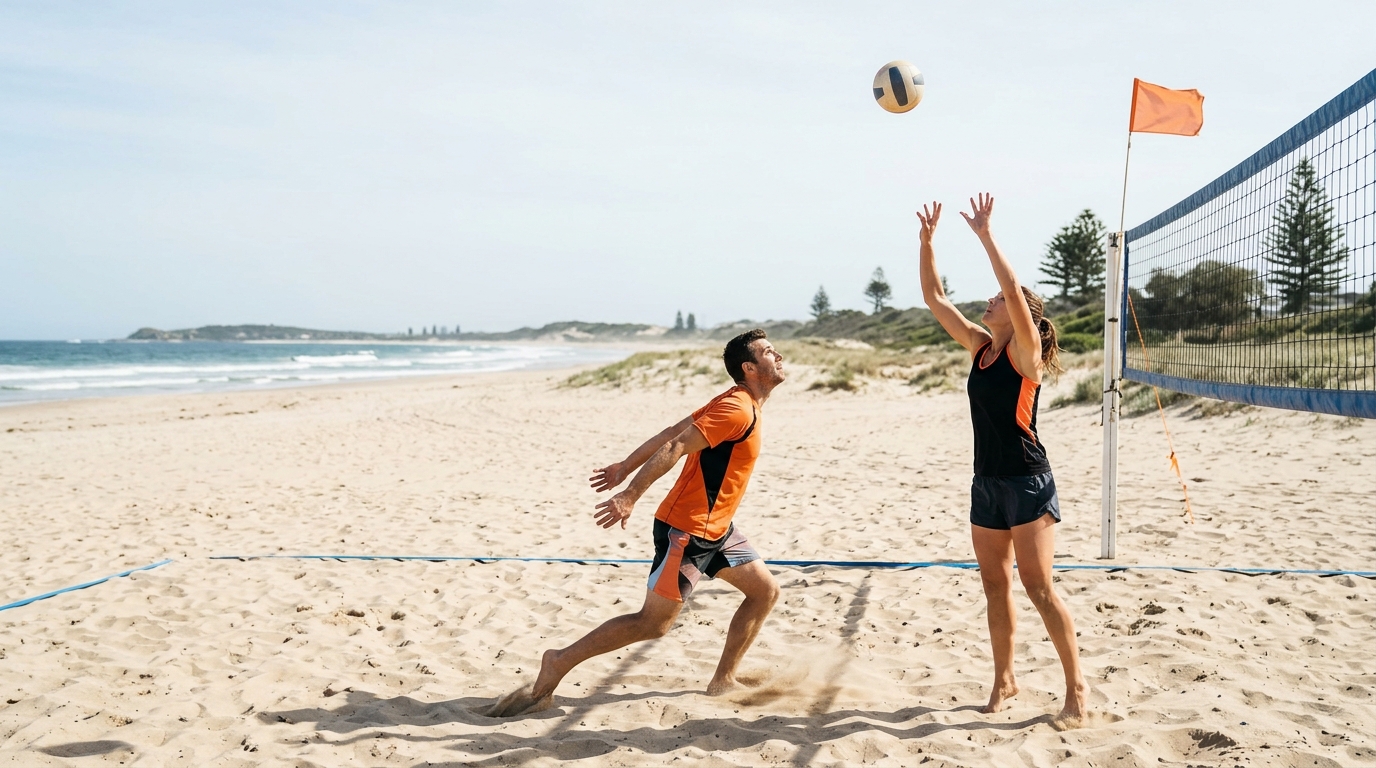
Beach volleyball asks two players to cover every skill, open space, and change in conditions. Sand slows the first step. Wind changes the ball’s flight. Sun, heat, and a smaller team make simple communication valuable on every rally. Learning beach volleyball sand and wind tactics gives developing players a clear way to handle those challenges without overcomplicating the game.
This guide focuses on practical doubles habits: moving efficiently in sand, organizing serve receive, using wind deliberately, and creating a basic blocker-defender system.
Learn What Changes on the Sand
Beach volleyball is more than indoor volleyball played outdoors. Official competition uses two-player teams on an 8-by-16-metre court. Each team has up to three contacts to return the ball, including a block touch, and every rally scores a point. The FIVB Official Beach Volleyball Rules 2025 to 2028 are the right reference for competition requirements, court dimensions, and scoring.
With only two players, both partners need to serve, receive, set, attack, block, dig, and communicate. That responsibility is challenging, but it also helps players develop a complete game.
Move before the ball moves you
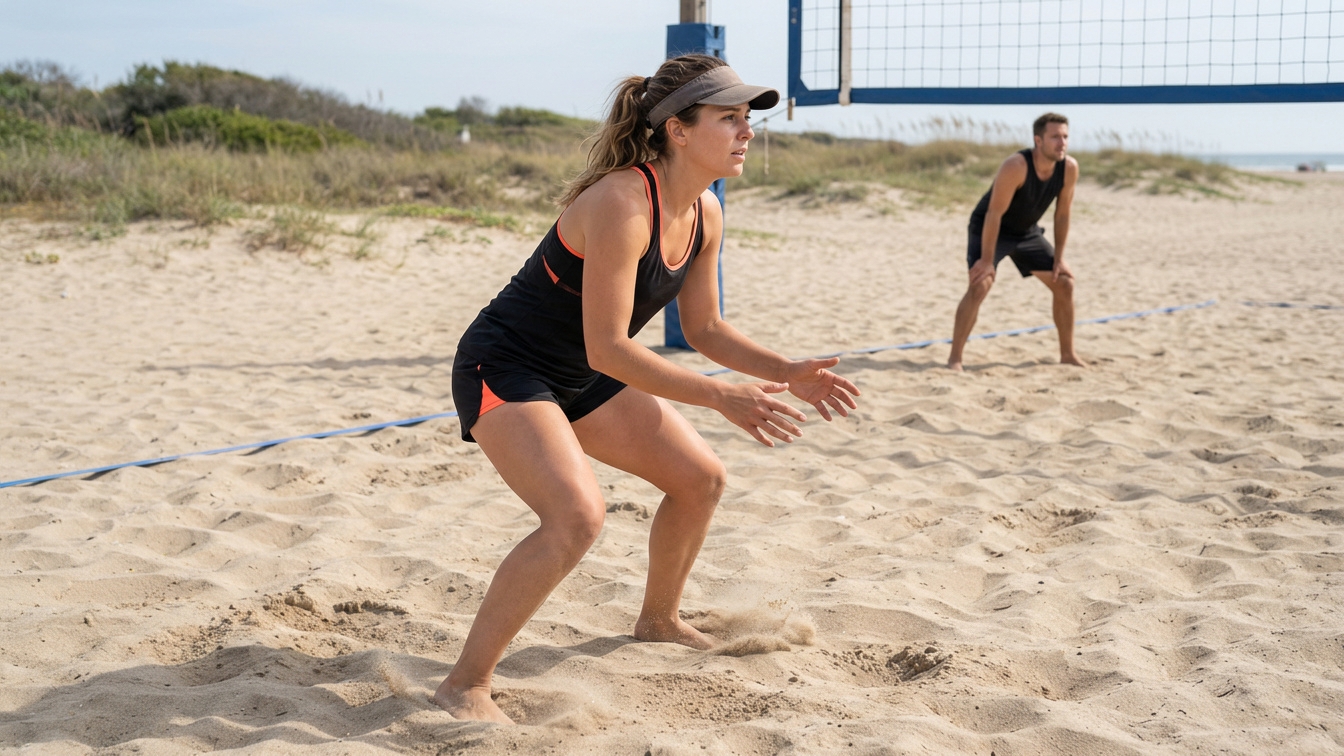
Sand absorbs force, so large steps and late changes of direction cost time. Start in a balanced, slightly lower ready position. Read the server, setter, or hitter early, then use small adjustment steps to arrive under control. When the ball is playable, plant your feet before passing or attacking instead of reaching from a rushed lunge.
After any move, recover quickly. If you dive or sprawl, get back to your feet and rejoin the play. The goal is efficient movement, not dramatic movement.
Build a Simple Two Player System
Divide serve receive clearly
Before every serve, agree on responsibility. A useful starting point is for each player to cover roughly half the court, with the player diagonal from the server responsible for the middle seam. Stand deep enough that you can move forward to a short serve. Backing up through sand to handle a deep serve is often harder and less controlled.
The player not receiving should start moving toward a setting target before the serve reaches their partner. That early movement makes the second contact easier. The pass should give the setter room to work, not drift so close to the net that wind turns it into an overpass.
Beach tactics build on fundamentals that still matter indoors. For technique work on consistent contact and purposeful targets, use our guide to volleyball serve techniques for every level.
Call the ball and the shot
Use short, repeatable calls. “Mine” removes doubt on the first contact. “Help” tells a partner an emergency second ball may be needed. After the set, call an open area or remind the attacker about the block. Keep the message brief enough to use while moving.
Communication also helps after errors. A missed serve or dropped ball should lead to a quick reset and a new plan. Our article on mental performance training for court sports athletes offers useful routines for refocusing under pressure.
Use the Wind Instead of Fighting It
Start each match with a wind check. Toss the ball, watch flags or nearby trees, and notice whether the wind moves from end line to end line or across the court. Conditions can change, so repeat the check after side changes. Your pair needs a shared plan for serves, passes, and high shots.
Keep passes lower in stronger wind
In calm conditions, a higher pass can give the setter time. In stronger wind, it may drift too far or become difficult to hand set. Use a lower, controlled pass toward a target in front of and slightly toward the middle of the court. Keep your stance low and arms ready for late adjustments.
The FIVB Beach Volleyball Drill Book advises players to adjust for wind when moving to the ball, keep passes lower as the wind strengthens, and develop serving accuracy with conditions in mind.
Serve with a clear purpose
Choose a target before serving. Into an end-line wind, a more direct serve may hold its line and create pressure. With a crosswind, use the expected drift to aim at a receiver’s inside shoulder or the space between partners. A deeper serve has more time to move, so it can be effective when you understand the direction.
Control matters more than force. Test one wind-adjusted target during warm-up, then use it when the match begins.
Connect Blocking and Defense
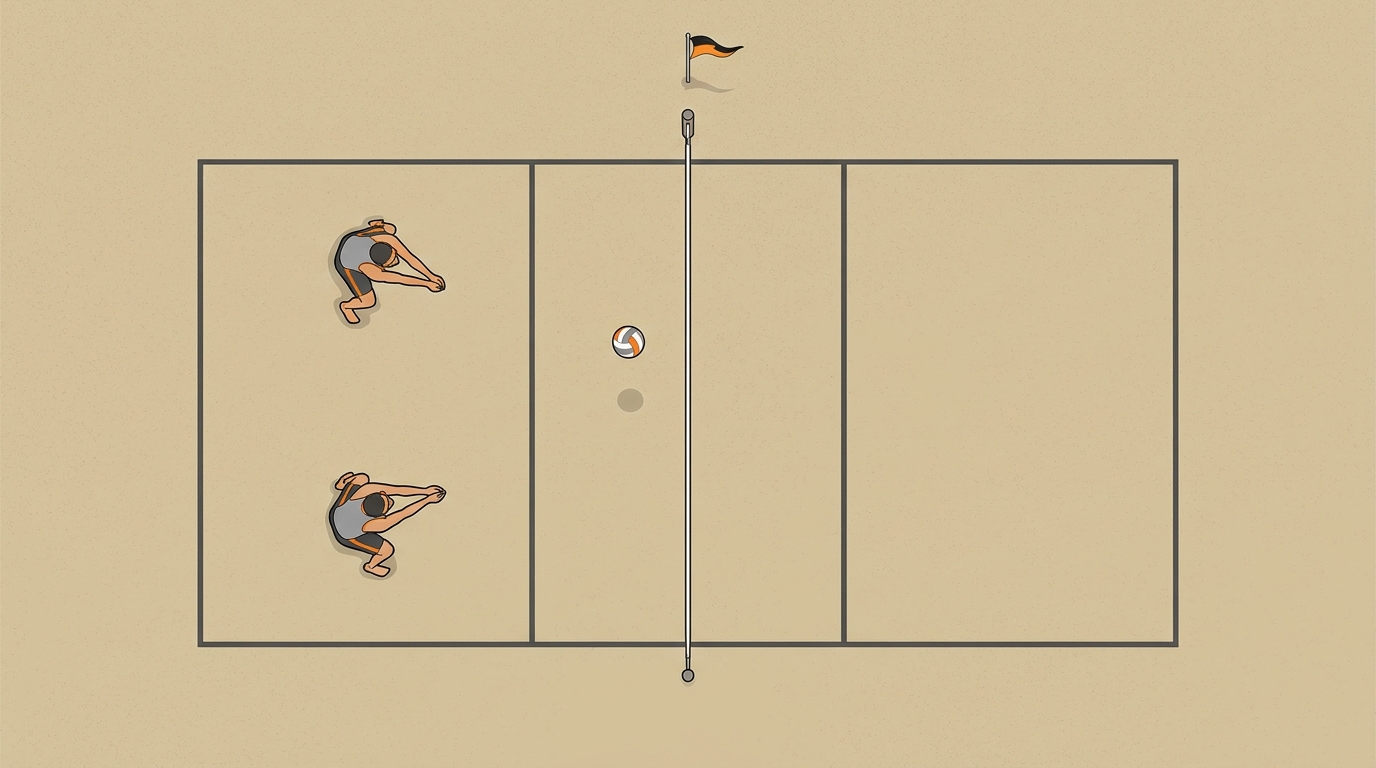
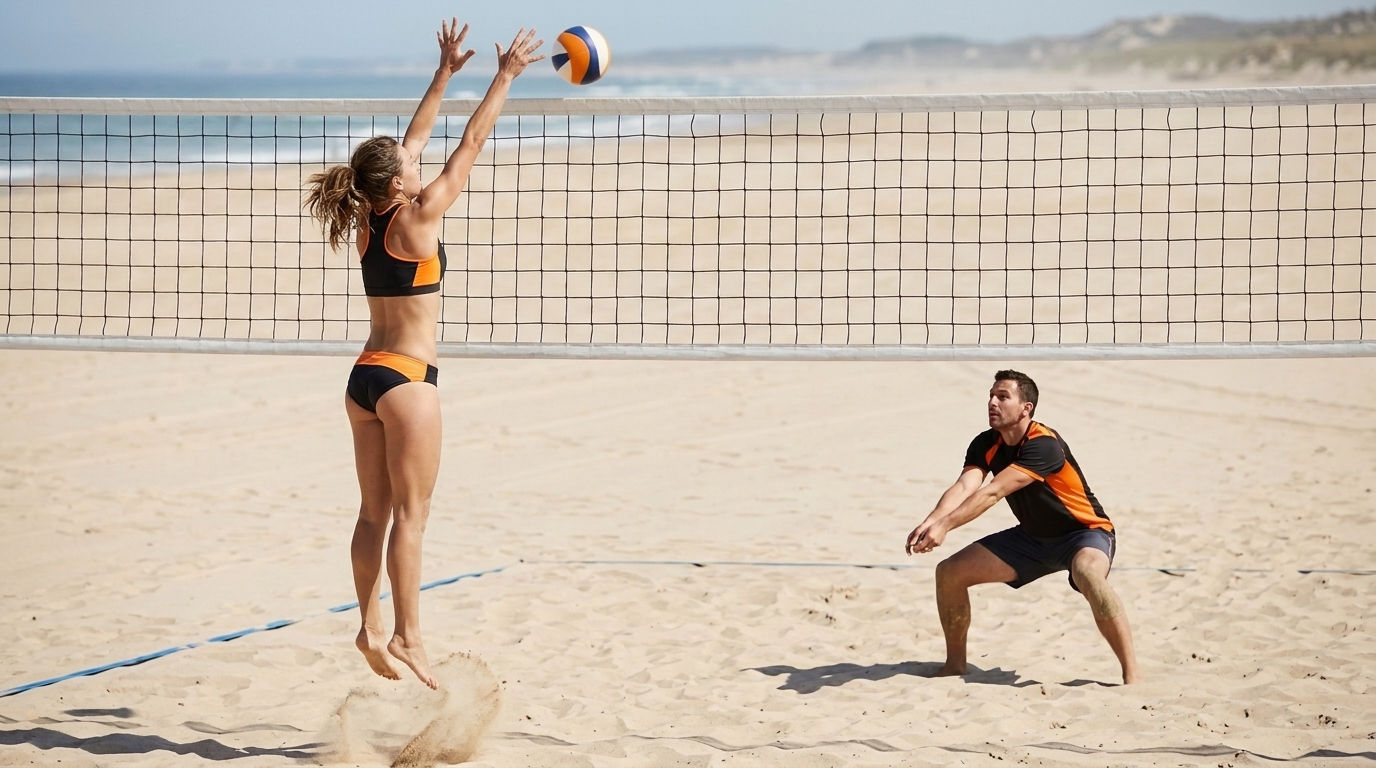
On a two-player team, defense works best when the blocker and defender agree on the space each will cover. A block can remove one attacking lane and make the defender’s job more predictable.
Use simple signals and roles
Before an opponent serves, the blocker can show a signal behind their back. A common system uses one finger for a line block, two fingers for an angle block, and a closed fist to show that the player will pull off the net and play defense. The defender starts in the space the block is not designed to cover.
USA Volleyball’s beach clinic guidance explains these signals, the pull-off decision, and why both partners should develop every skill. Run one clear plan together rather than two different ideas independently.
Know when to pull off
Stay near the net when an opponent has a close, strong attacking option and a block can take away part of the court. Pull off when the attacker is far from the net, the set is poor, or a hard downward attack is unlikely. Make the decision early enough to arrive balanced.
Use a 20 Minute Wind Practice
Spend five minutes on sand movement with short shuffles, forward-backward steps, controlled stops, and partner tosses. Use five minutes to serve at one target with the wind, then from the opposite side to compare the ball’s drift.
For five minutes, repeat pass-set-attack actions. Keep the pass lower if the wind is strong and use a forearm set when that is safer. Finish with five minutes of blocker-defender points. Before every serve, show a signal, state the defensive responsibility, and reset after the rally.
Hard sand sessions can create fatigue through repeated jumps, sprints, and dives. Bring water, seek shade between games when possible, and build lighter days into a busy week. These habits fit naturally with our recovery strategies for court sports athletes.
Beach Volleyball Sand and Wind FAQ
How should beginners play beach volleyball in wind?
Start with lower passes, simple targets, and clear calls. Watch how wind moves a practice serve, then adjust your starting position and aim. Favor control until conditions are familiar.
Who covers the middle in beach volleyball?
Agree before the serve. A common serve-receive system gives the player diagonal from the server responsibility for the middle seam, but partners should adjust to their strengths and the wind.
Should both beach volleyball players block?
Both players should learn blocking and defense. During a point, one player normally blocks or pulls off while the other defends the uncovered space. The roles can change with the opponent and match plan.